High security · Parkway
Safe Opening & Combination Change in Parkway
A customer's rifle safe at the range has a dial that simply will not respond to the combination written on the sales receipt from years ago.
In plain words
Changing a combination is not only for a safe that has stopped opening. Businesses routinely have a working safe recombined the moment someone who knew the old code leaves, retires or changes roles, because a combination known outside the current staff is a loose end worth closing on its own. The visit is short when the safe already opens fine: confirm authority, dial or key in the old combination, set a new one, and test it before anyone signs off on the work.
How the visit goesThe pharmacy's drop safe has a keypad that finally lost power for good, and the little override key that was supposed to live behind the counter cannot be found anywhere.
Safe Opening & Combination Change
How the visit goes
Looking for a relocker or prior damage
Some safes include a relocker, a small device built to jam the bolt work until a trained technician services it, if the case is drilled in the wrong place, dropped, or exposed to fire. The locksmith looks for pry marks, drill attempts, scorching or a history of the safe being moved or dropped, since any of these can explain a lock that suddenly refuses a combination that worked yesterday. Recognizing a tripped relocker early changes the plan: the fix is mechanical, freeing or replacing the relocking mechanism, rather than another attempt at the original combination or a straightforward reset.
Drilling through a chosen, repairable point
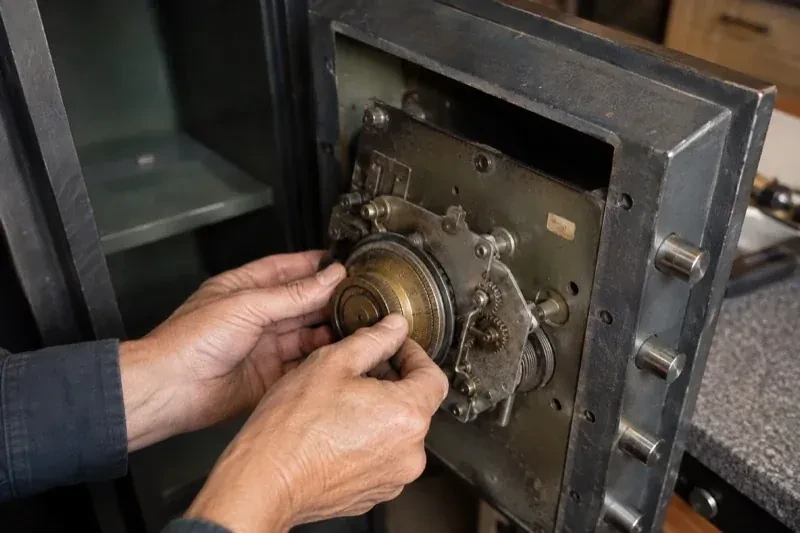
When manipulation, decoding and the electronic reset path all fail to open the safe, drilling is explained to the owner before it begins, aimed at a specific point the lock manufacturer's own service documentation identifies as both reachable and safe to repair afterward. A borescope is used through the drilled hole to view the lock's internal parts directly and manipulate or bypass them without further damage. The aim is to affect nothing beyond that single hole, patched or plugged as one of the last steps of the visit, though the number of holes needed and any effect on the safe's rated protection level depends on its construction and is addressed with the manufacturer's approved repair method.
Confirming what belongs behind the door
For a safe used to store firearms, the visit is a natural moment to confirm the storage arrangement inside still matches what the applicable federal requirements for a business expect, since those rules cover the container, the room around it and how access is limited to authorized people. For a safe holding cash, records or client property, checking that nothing was disturbed while the lock was being worked on, and that the new combination is set before anything is put back, closes the loop on the same visit rather than leaving it for later.
Safe Opening & Combination Change
In the van
Repair plug and patch plate
Manipulation and tension tools
Replacement dial and ring
Nine-volt and lithium batteries
Spindle and drive cam
Safe Opening & Combination Change
What affects the quote
Whether drilling turns out to be necessary
Manipulation, decoding and manufacturer reset paths are tried first; drilling, a repair plug and any replacement lock only enter the picture once those routes are exhausted.
Distance to the safe's location
Travel time to the site is part of every call-out, and a location further from the locksmith's usual service area is reflected in the quote alongside the work itself.
Safe size and case construction
A compact drop safe with a thin body is generally quicker to assess than a large floor safe with a thick composite wall, and the tools involved differ accordingly.
What to have ready
- Does the handle turn normally, or does it feel stuck?
- Does the keypad light up or make sounds when pressed?
- Has the safe been through a fire, flood or break-in attempt?
Safe Opening & Combination Change: questions
QuestionsDo drop safes or under-counter cash safes work the same way as a larger floor safe?
The identification step is the same regardless of size, but the lock inside is not assumed from the safe's size: a small drop safe or under-counter unit can carry anything from a basic keypad to a high-security lock, so each is identified on its own before manipulation, reset or a combination change proceeds, with the same care around authority and aftercare applying equally.
My safe was in a fire or a flood. Does that change how it gets opened?
It can. Heat or water exposure sometimes trips a relocker or damages the bolt work independently of the combination lock, so the locksmith checks for that first rather than assuming the lock itself has failed. A safe with fire-rated insulation may also need that lining checked once open, separately from the lock work.
Do you need to see proof that I own the safe before opening it?
Yes, and it is meant as a protection rather than a hurdle. For a business, identifying yourself as the owner, manager or an authorized employee is usually enough. For an estate, a secondhand purchase or a change of ownership, a bill of sale, transfer document or executor's paperwork fills the same role. This step protects whoever actually has a claim on what is inside the safe, which includes you.