High security · Kitchener
Safe Opening & Combination Change in Kitchener
A customer's rifle safe at the range has a dial that simply will not respond to the combination written on the sales receipt from years ago.
In plain words
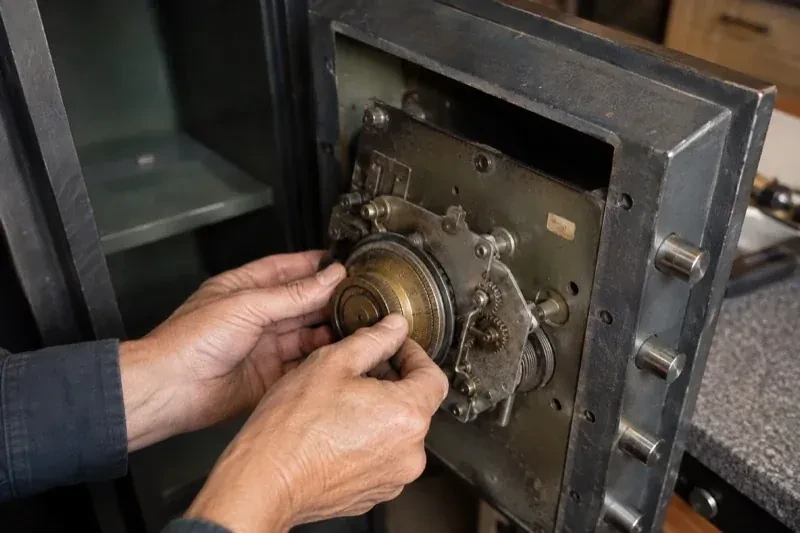
Safe opening favours the gentlest method that fits the particular safe and lock, with drilling kept as a later option rather than a first resort. Manipulation and decoding are tried first for a mechanical dial, and a manufacturer reset or override path where one exists for an electronic keypad. Where those routes are unavailable or exhausted, drilling enters the conversation, aimed at a point the maker's own service literature marks as reachable and repairable. Most safes that still have their original lock in reasonable condition never reach that last rung at all.
How the visit goesThe new manager took over the shop last month and only now needs the back-office safe open, but the combination the previous owner was supposed to leave in writing never turned up anywhere in the handover file.
Safe Opening & Combination Change
How the visit goes
Reading the safe before touching it
Every safe carries clues about what is inside its lock. A manufacturer's data plate, usually on the door or inside the frame, often names the brand, model and sometimes the lock's own security rating. The dial style, the keypad's shape and buttons, and whether a key cylinder sits alongside the combination lock all narrow down the lock family before a single tool is used. Older safes without a legible plate are identified from the case shape, the handle style and the dial ring instead. Getting this identification right decides which manipulation technique, which reset procedure or which manufacturer tool applies, and it is the difference between a clean opening and a guess.
Resetting an electronic keypad
Electronic safe lock recovery options vary by model: some support a manufacturer reset code entered through the keypad or an emergency key hidden behind a cover plate, while others need a small reset tool connected to a port on the back of the lock, which sits inside the secure container and still needs the door opened by other means first. The locksmith works through the specific model's own procedure where one exists, which for many models restores factory defaults or wipes stored codes rather than revealing the old one. Where the keypad itself has failed rather than merely losing power, the input unit is replaced and reconnected to the existing lock body before any new code is set.
A safe that opens the same way every time
The visit finishes with the door cycled several times under the new combination, both open and closed, so the result is proven rather than assumed. The handle is checked for smooth, even movement, and the bolt work is watched to confirm it retracts and extends fully on each attempt. Anything noticed along the way, a stiff dial, a keypad that needs a firmer press, or a hinge that could use attention, is pointed out plainly so nothing is left as a surprise. You are shown the working combination yourself before the locksmith leaves, rather than simply being told that it works.
Safe Opening & Combination Change
In the van
Repair plug and patch plate
Manipulation and tension tools
Replacement dial and ring
Nine-volt and lithium batteries
Spindle and drive cam
Safe Opening & Combination Change
What affects the quote
Safe size and case construction
A compact drop safe with a thin body is generally quicker to assess than a large floor safe with a thick composite wall, and the tools involved differ accordingly.
Whether model or service records are available
A visible data plate, a purchase receipt or a manual on hand speeds up identifying the exact lock; a safe with none of that takes a few extra minutes to assess on site.
Distance to the safe's location
Travel time to the site is part of every call-out, and a location further from the locksmith's usual service area is reflected in the quote alongside the work itself.
What to have ready
- Is the lock a dial, a keypad, or a key?
- Is the safe bolted down, built in, or freestanding?
- Does the handle turn normally, or does it feel stuck?
Safe Opening & Combination Change: questions
QuestionsDo drop safes or under-counter cash safes work the same way as a larger floor safe?
The identification step is the same regardless of size, but the lock inside is not assumed from the safe's size: a small drop safe or under-counter unit can carry anything from a basic keypad to a high-security lock, so each is identified on its own before manipulation, reset or a combination change proceeds, with the same care around authority and aftercare applying equally.
My safe was in a fire or a flood. Does that change how it gets opened?
It can. Heat or water exposure sometimes trips a relocker or damages the bolt work independently of the combination lock, so the locksmith checks for that first rather than assuming the lock itself has failed. A safe with fire-rated insulation may also need that lining checked once open, separately from the lock work.
Do you need to see proof that I own the safe before opening it?
Yes, and it is meant as a protection rather than a hurdle. For a business, identifying yourself as the owner, manager or an authorized employee is usually enough. For an estate, a secondhand purchase or a change of ownership, a bill of sale, transfer document or executor's paperwork fills the same role. This step protects whoever actually has a claim on what is inside the safe, which includes you.